

Amazon Design
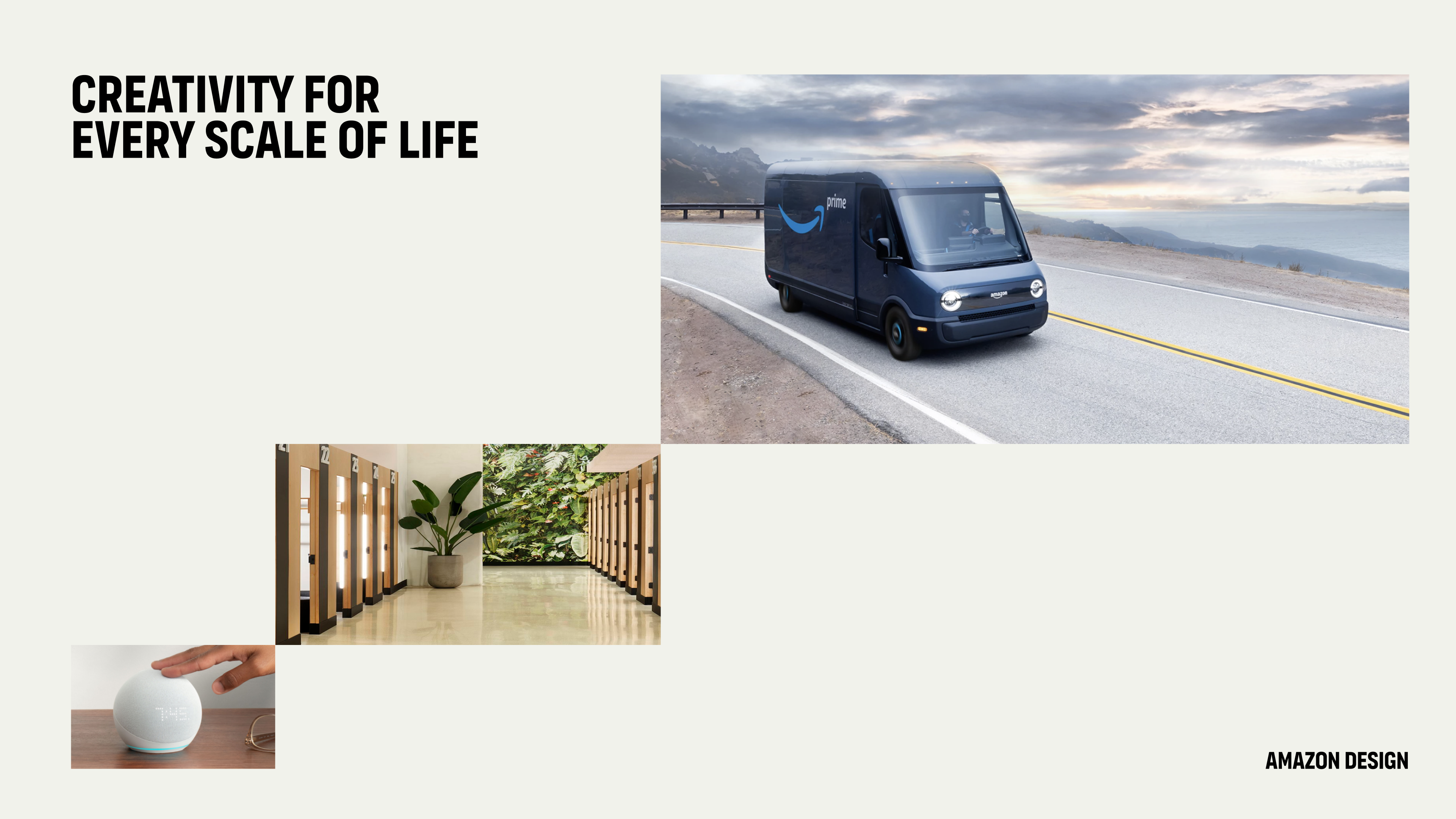
The Amazon Design Excellence team led a rebrand for Amazon's global design community. Athletics NYC built the strategic framework — then handed it off. I came in to resolve the identity, build the application layer, and get it across the finish line.
March 2024 – October 2024
Brand Design
Creative Direction
Visual Designer
Production
Context
My role was Visual Designer on the Amazon Design Excellence, a six-person team within Amazon's Devices and Services organization — responsible for brand application, system development, and production across all touchpoints. Athletics NYC had led strategy and framework development through early 2024; what they couldn't fully resolve from the outside became my scope. The brand went live in October 2024, approximately six months after handoff.
Opportunity
Two problems needed solving. The first was completion — Athletics had delivered roughly 80% of the system, but the core identity was unresolved, the application layer unbuilt, and the guidelines unwritten. The second was scale — ADX serves 5,000+ designers across Amazon, and a brand system is only as useful as the people who can operate it. Whatever got built needed to work without a designer in the room.
Key tension: The agency engagement had ended before the system was complete, leaving the core identity unresolved and the application layer unbuilt.
Process
Landing the Core Identity
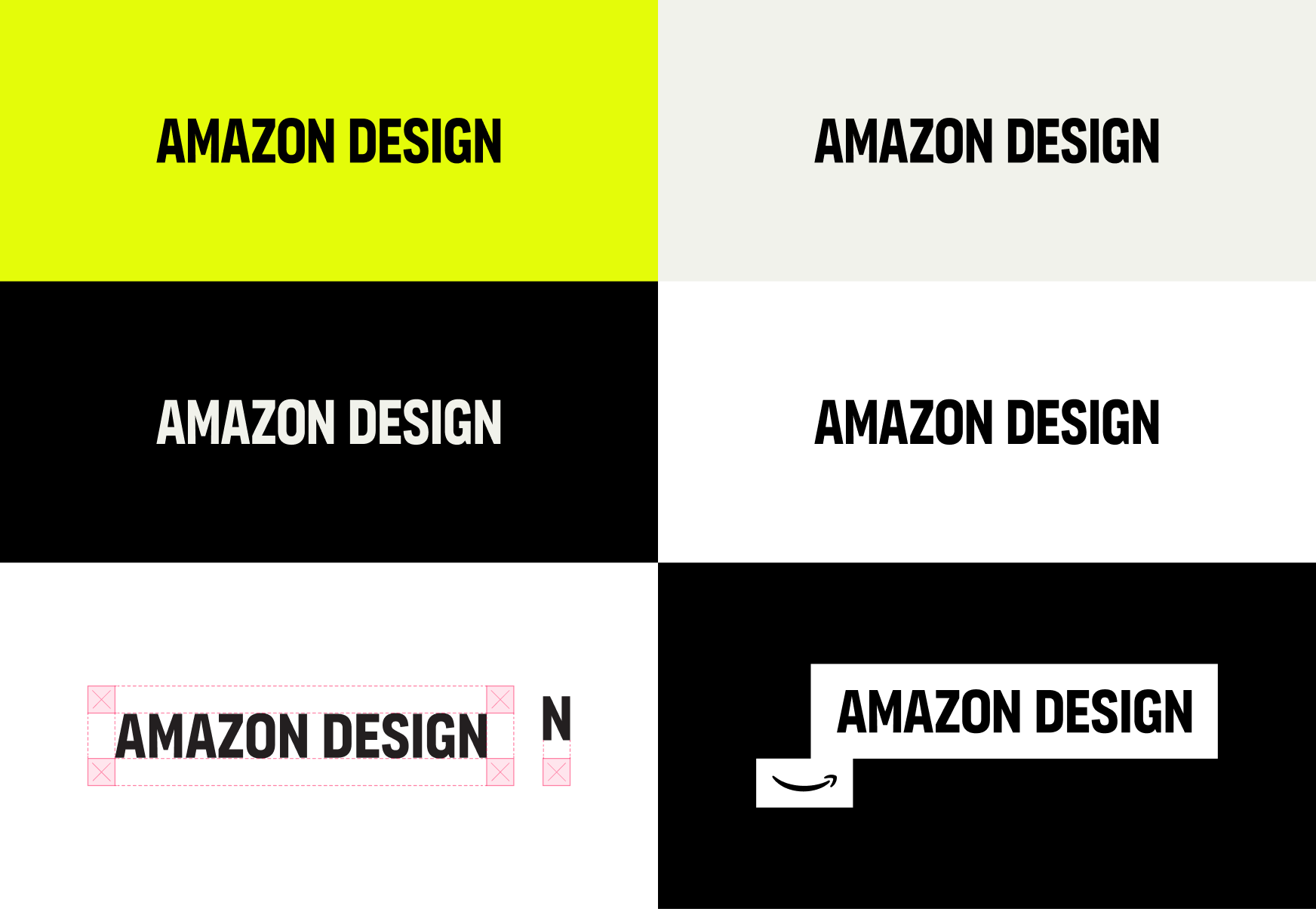
Athletics had presented multiple wordmark directions without landing on something the team could commit to. The gap wasn't in the quality of their work — it was in the internal context an outside agency can only partially access. I worked within the existing direction, stress-testing decisions with my team and creative director across the wordmark, type system, color behavior, photography, scale, and acceptable use until we reached something resolved — the fixed point everything else would reference.
Building the Application Layer
With the identity resolved, the work shifted to the system in the world — physical activations across conferences and events, collateral, motion, and the amazon.design hub. The template system was built around the tools non-designers actually had access to, so anyone could produce on-brand work without routing through a designer (namely recruiting and the ADX team). Additionally, this brand was aimed directly at designers who will certainly let it be known if there are incongruities in how a system is communicated.
Designing for Scale
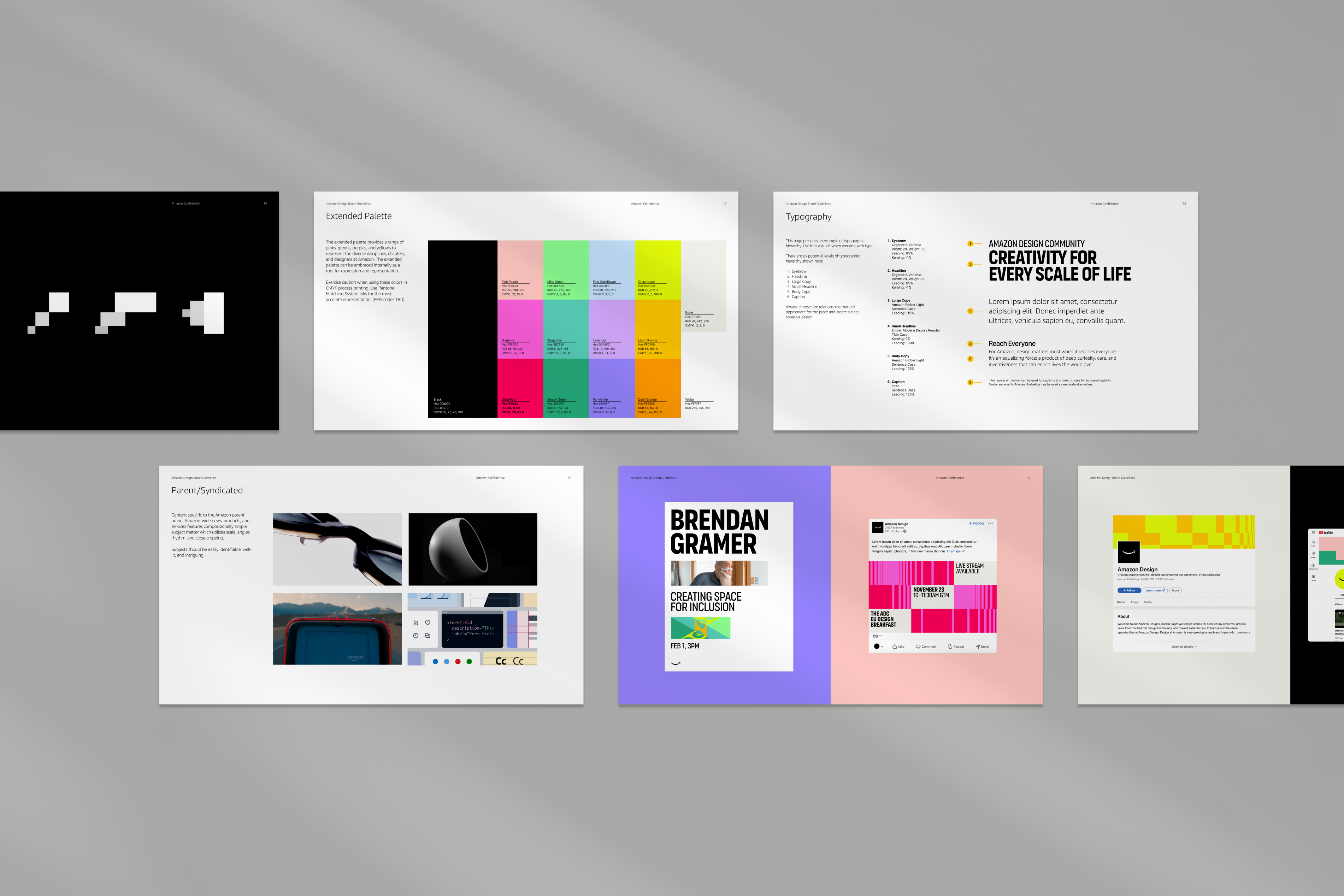
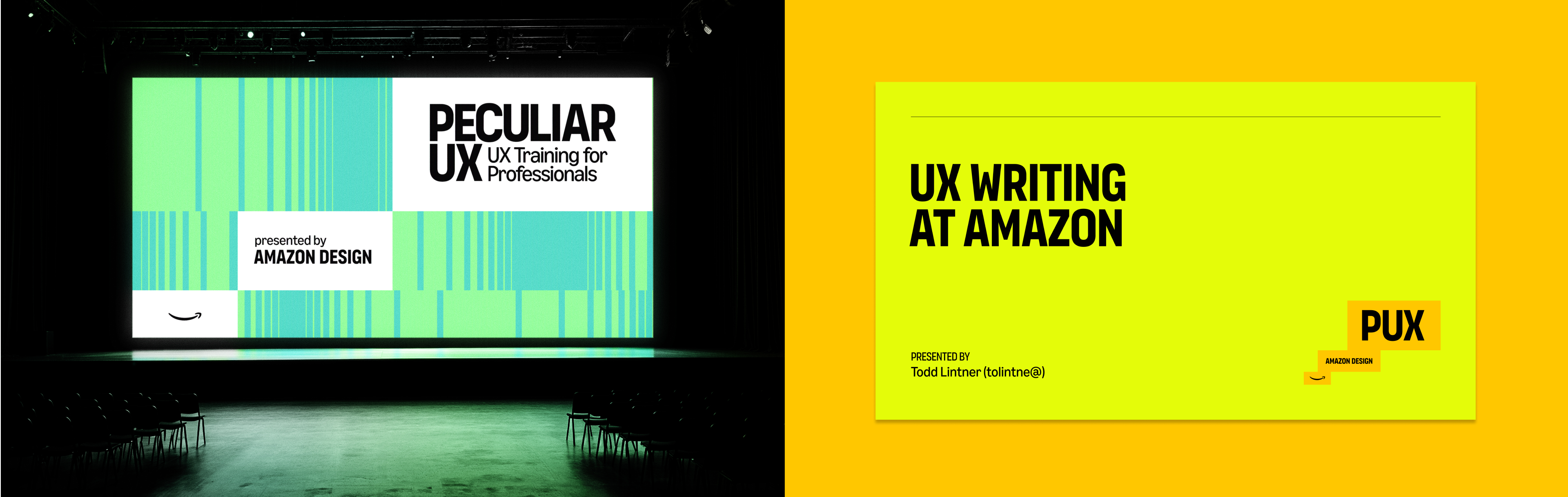
The brand couldn't live with the ADX (particularly myself, as the only designer) as its sole operator. I built a template system across multiple platforms and formats — accounting for real constraints like security limitations and the tools non-designers actually had access to — so anyone could produce on-brand work independently. Presentations, recruiting materials, learning and development assets: the goal was removing the design team as a bottleneck without sacrificing quality.
The Work
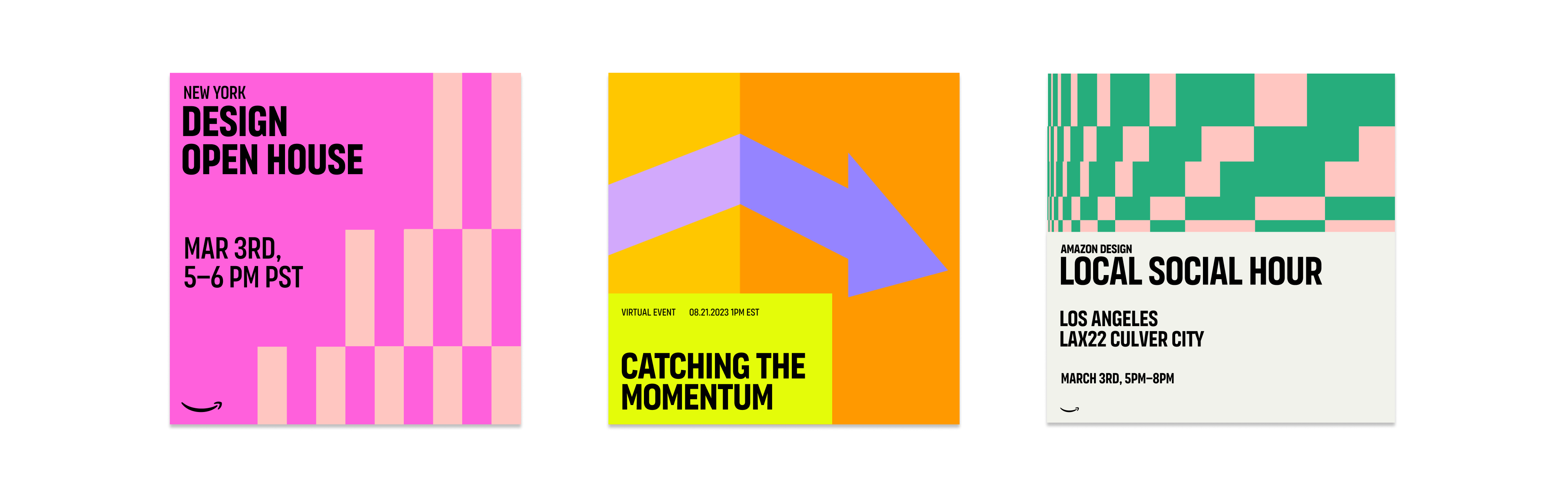
The following work spans the full arc of the engagement — from identity resolution through physical activation, digital application, and templates. Where relevant, context is provided for work that didn't reach final deployment.
Design Hub
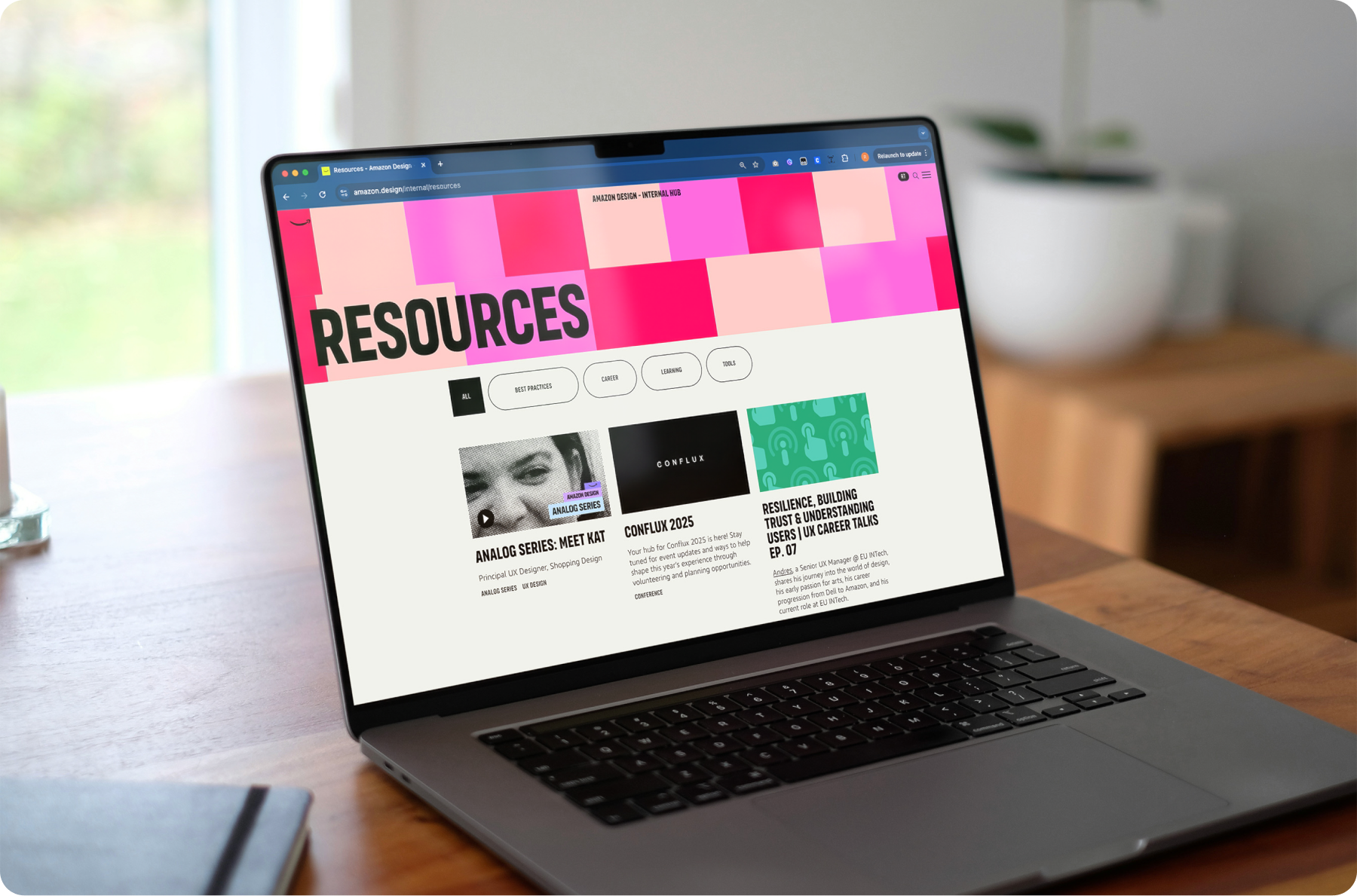
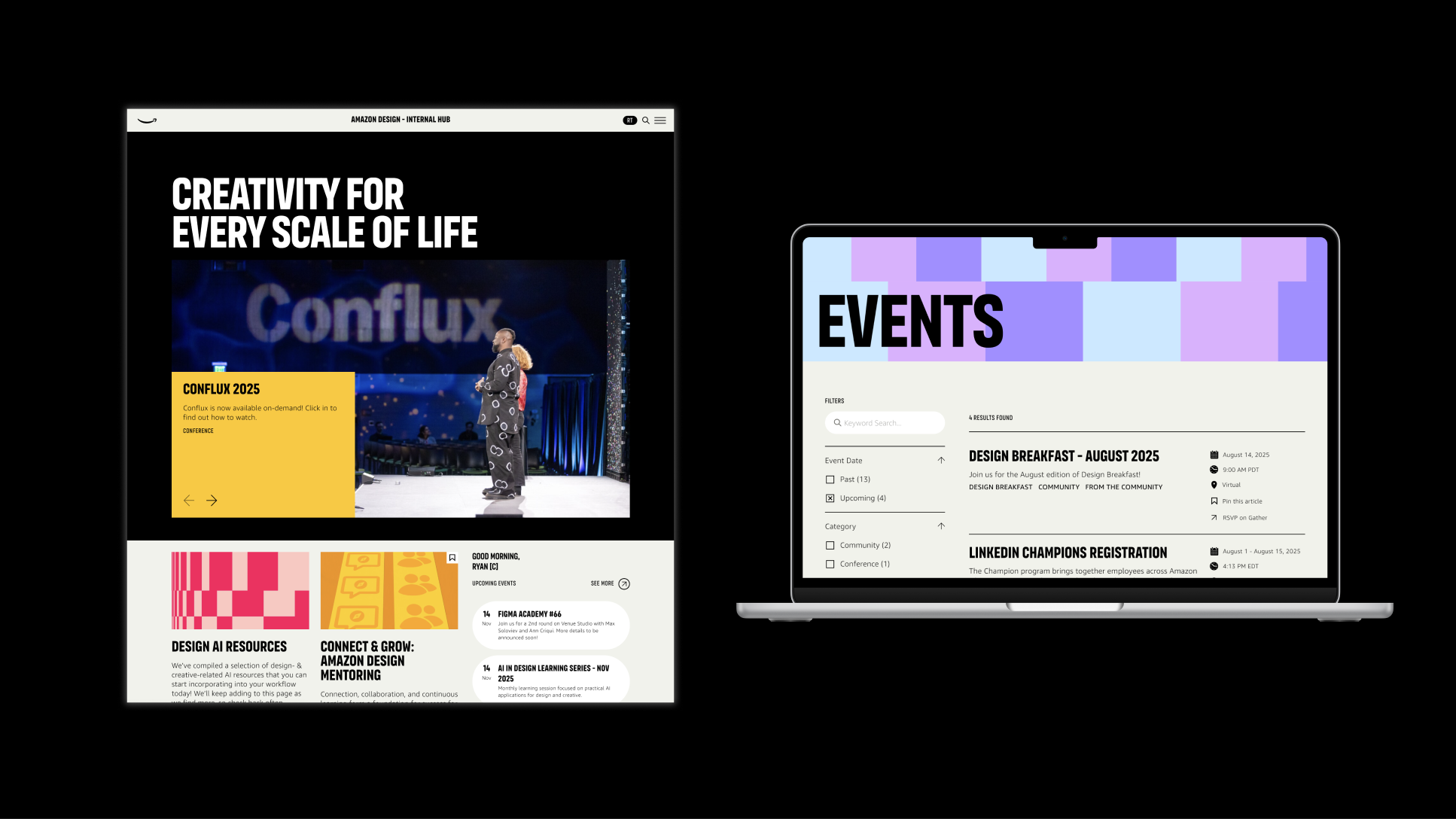
The amazon.design hub launched alongside the brand in October 2024 as a unified home for Amazon's design and creative community — an internal portal consolidating tools, resources, and information for employees, and an external-facing site focused on recruiting and representing the work Amazonians do. My contributions spanned both: interface and experience design, content design, scroll-interactive motion, and deployment across the internal and external properties.
Content Systems
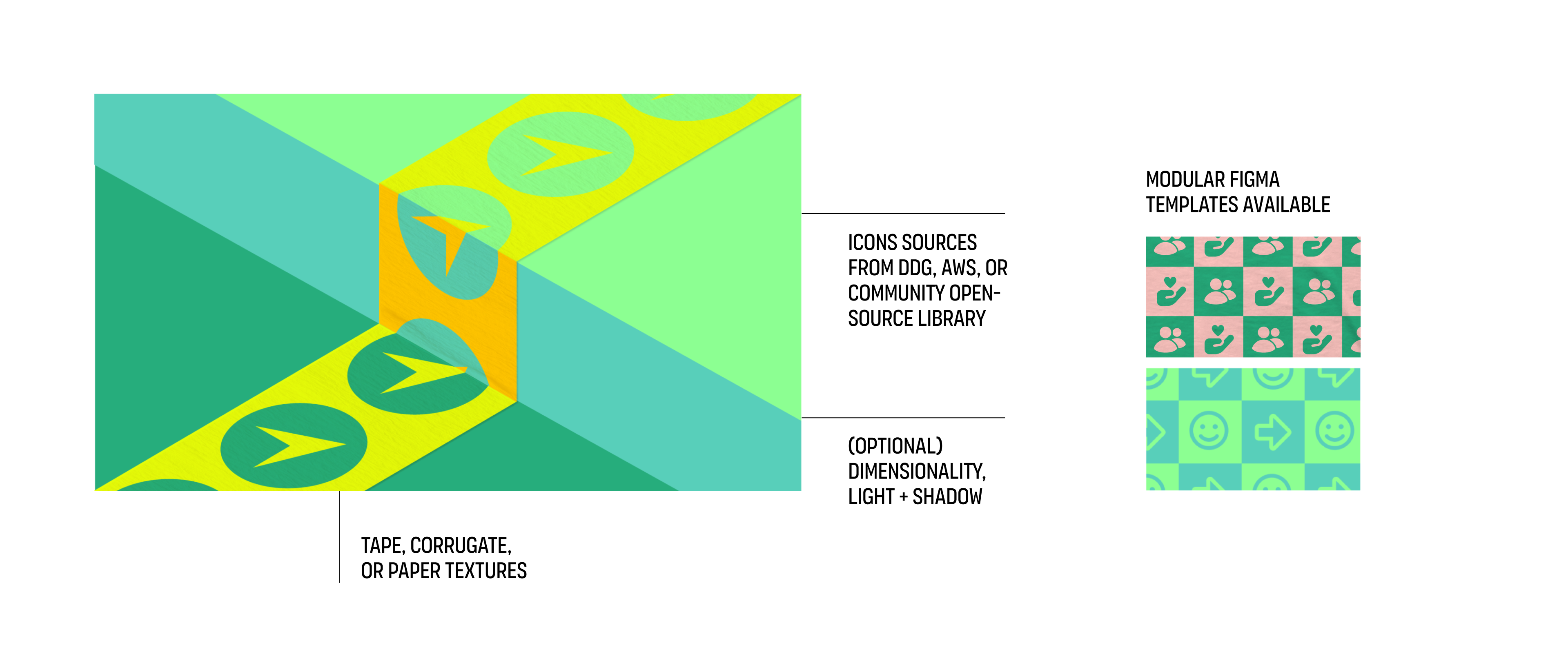
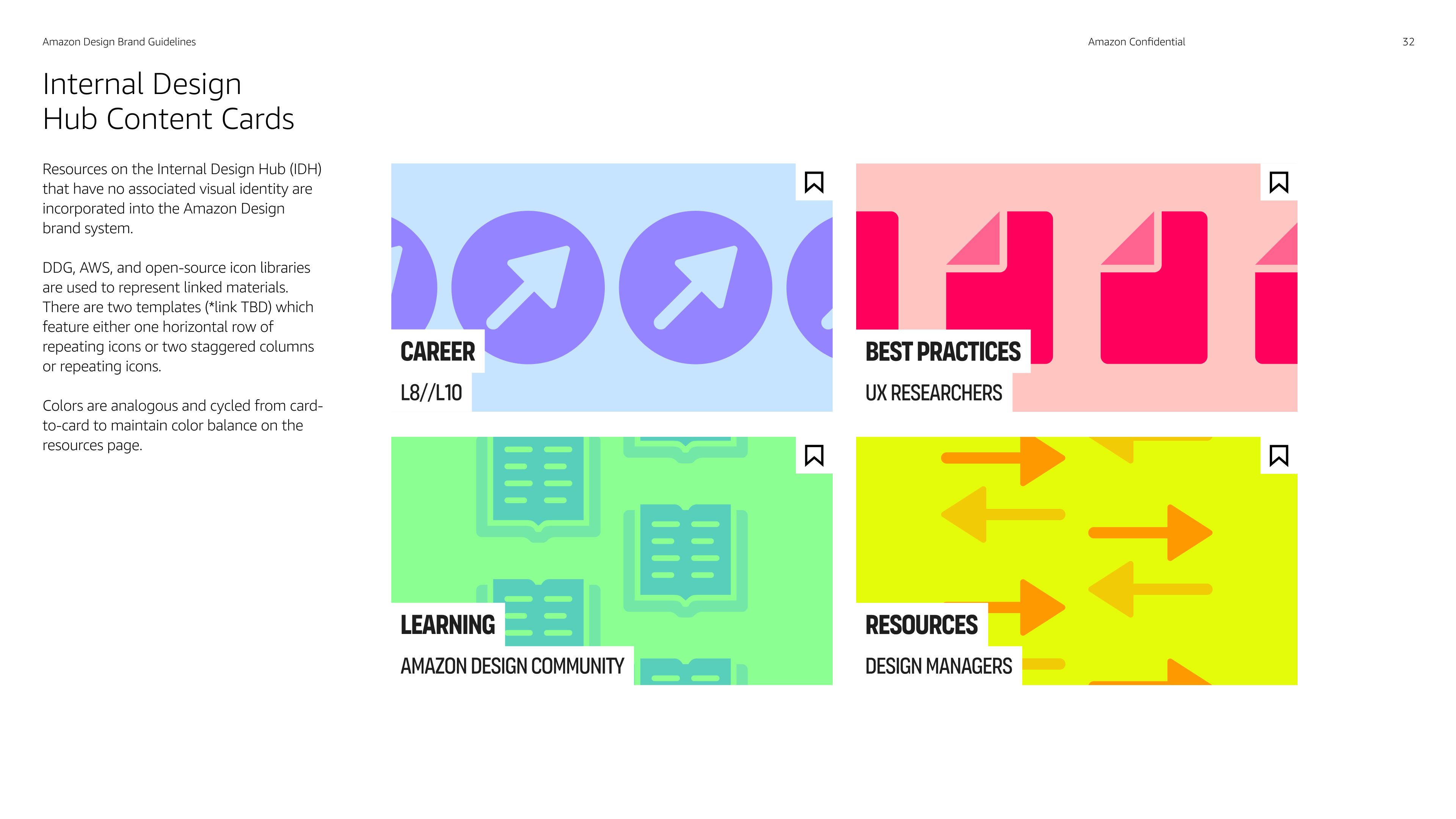
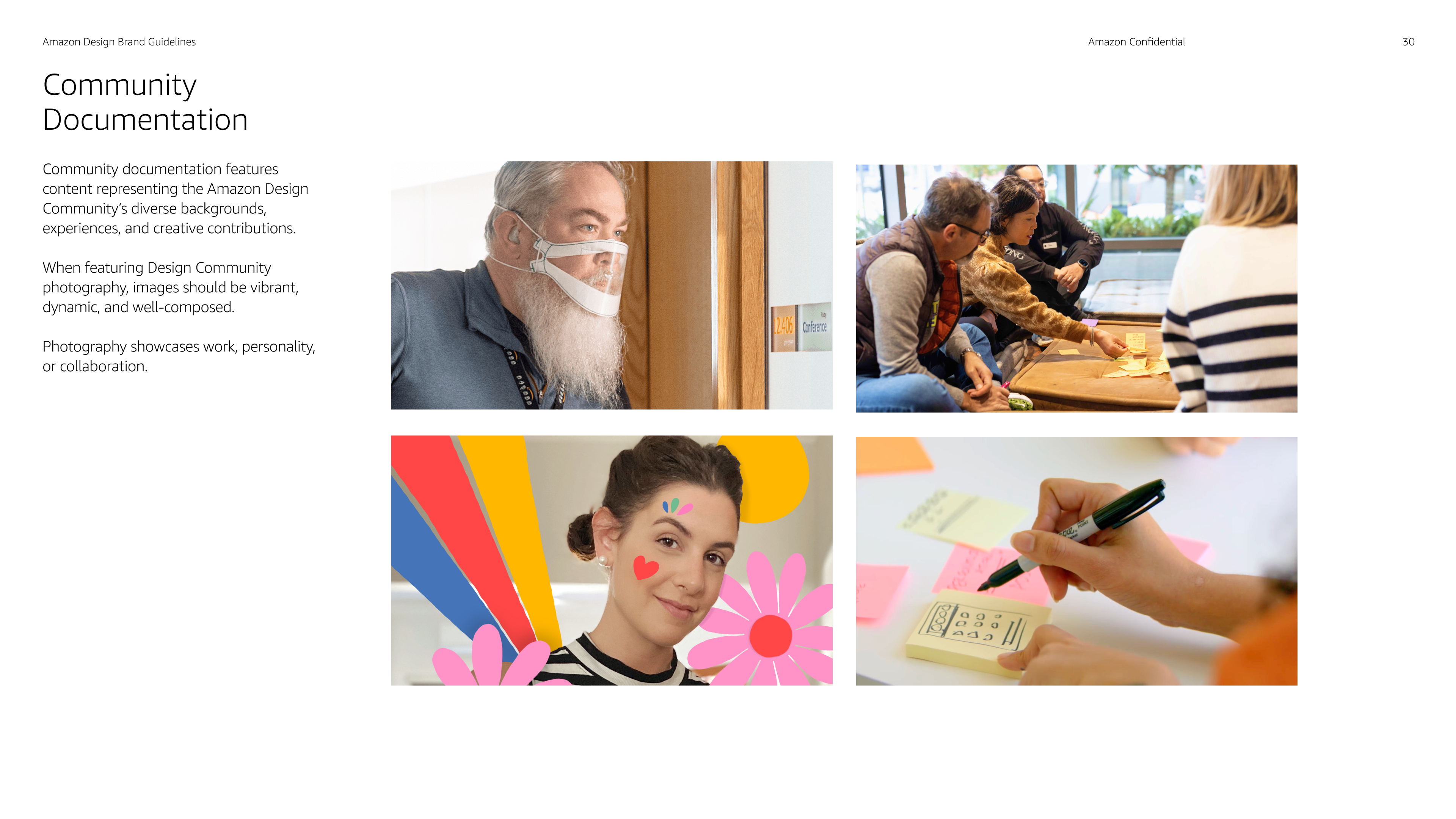
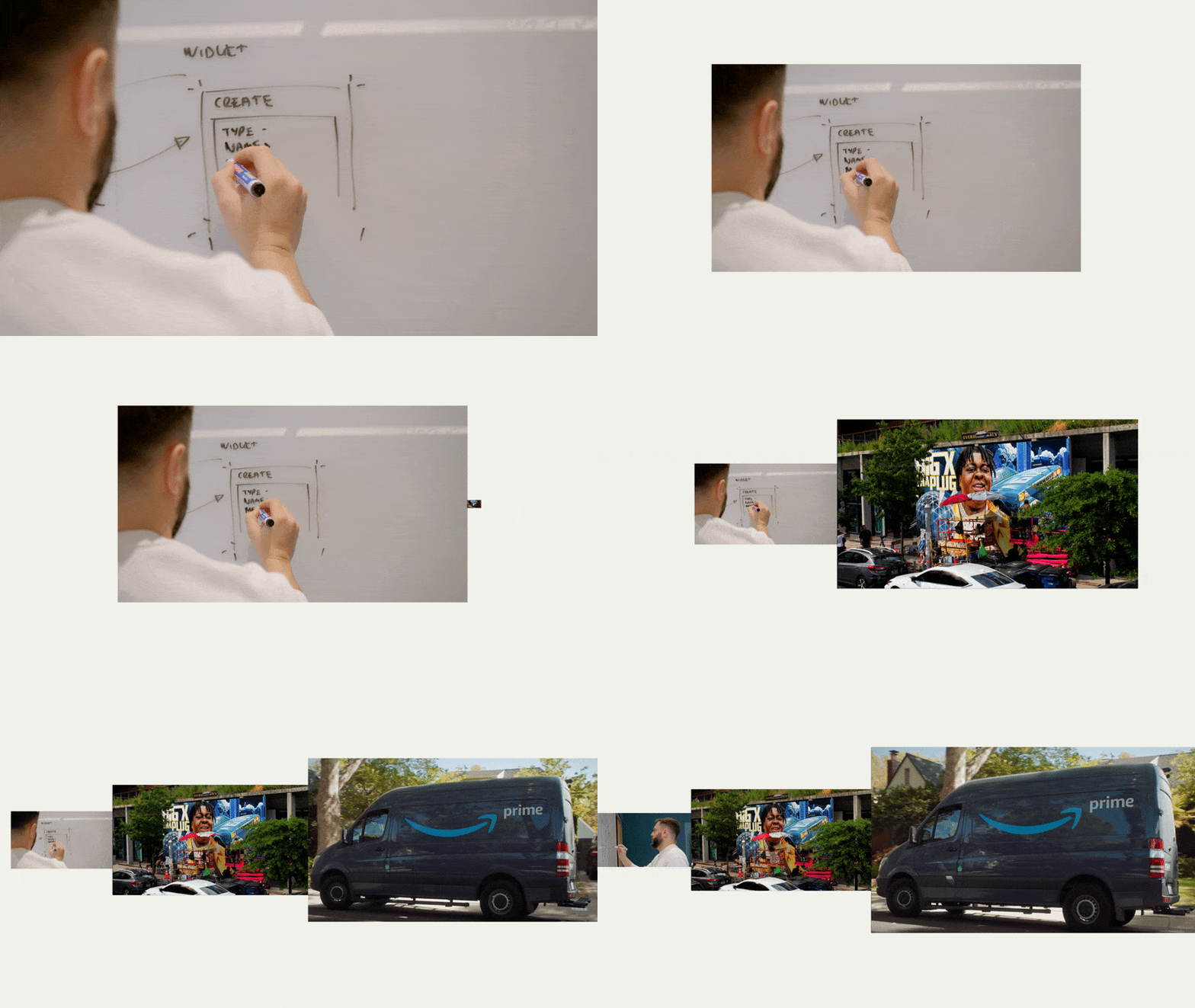
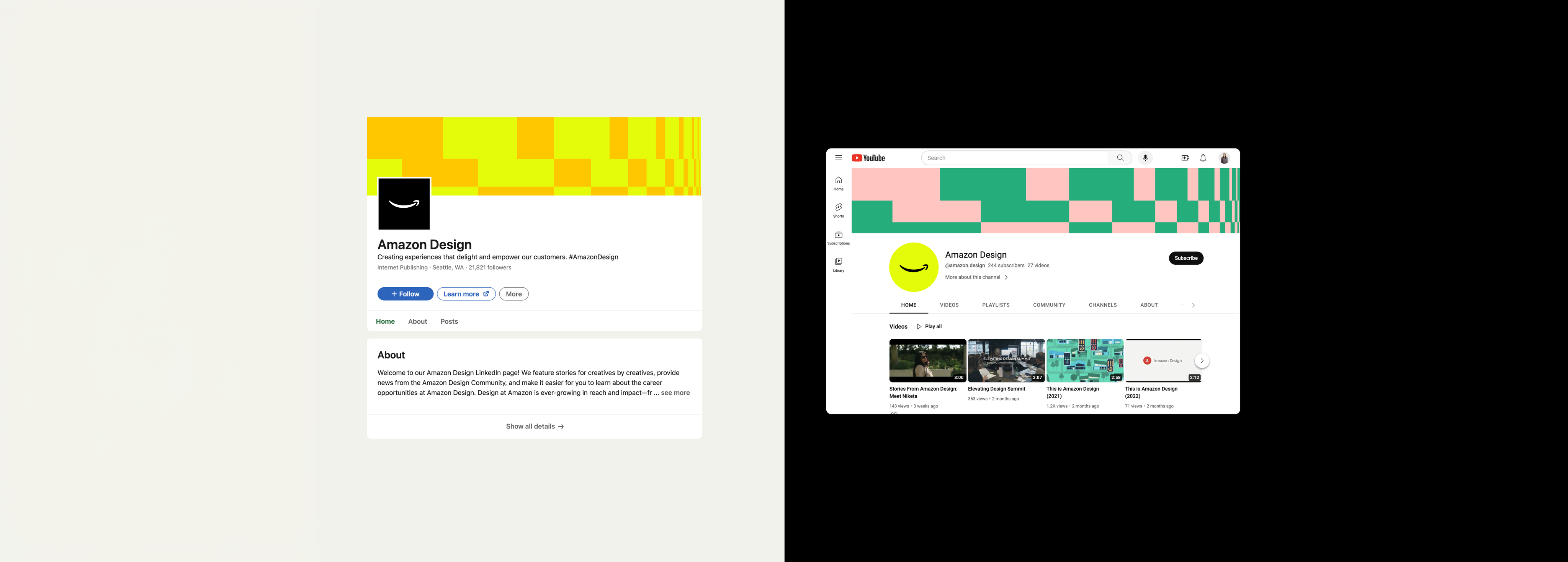
The brand guidelines documented a flexible content system for use across the hub, communications, and programming — covering illustration style, photography direction, color application, and content card design. The system extended to owned social channels, with assets designed and deployed across LinkedIn and YouTube. Built as a toolkit to give non-designers, external partners, and teams enough guidance to produce on-brand content independently.
Physical Activations
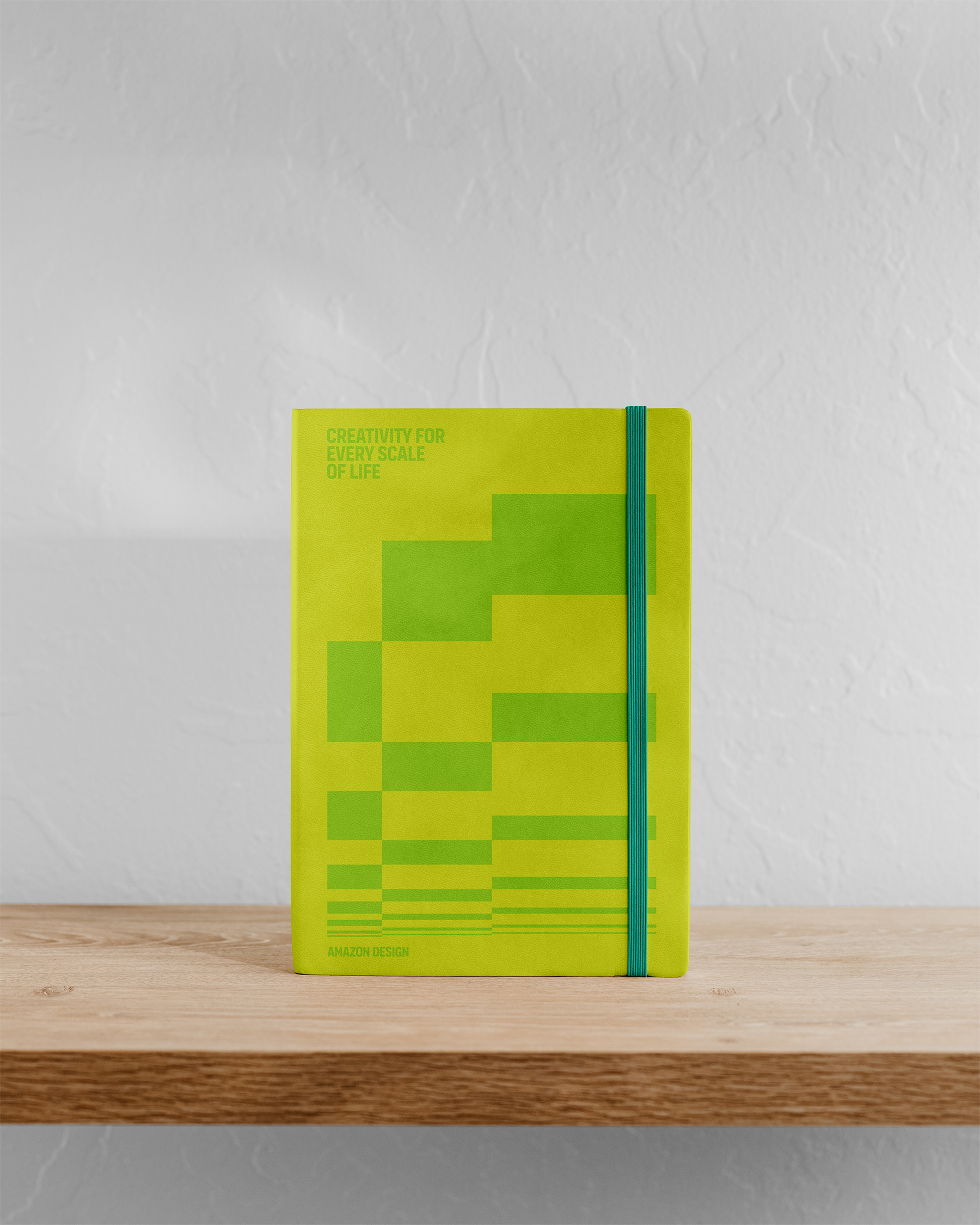
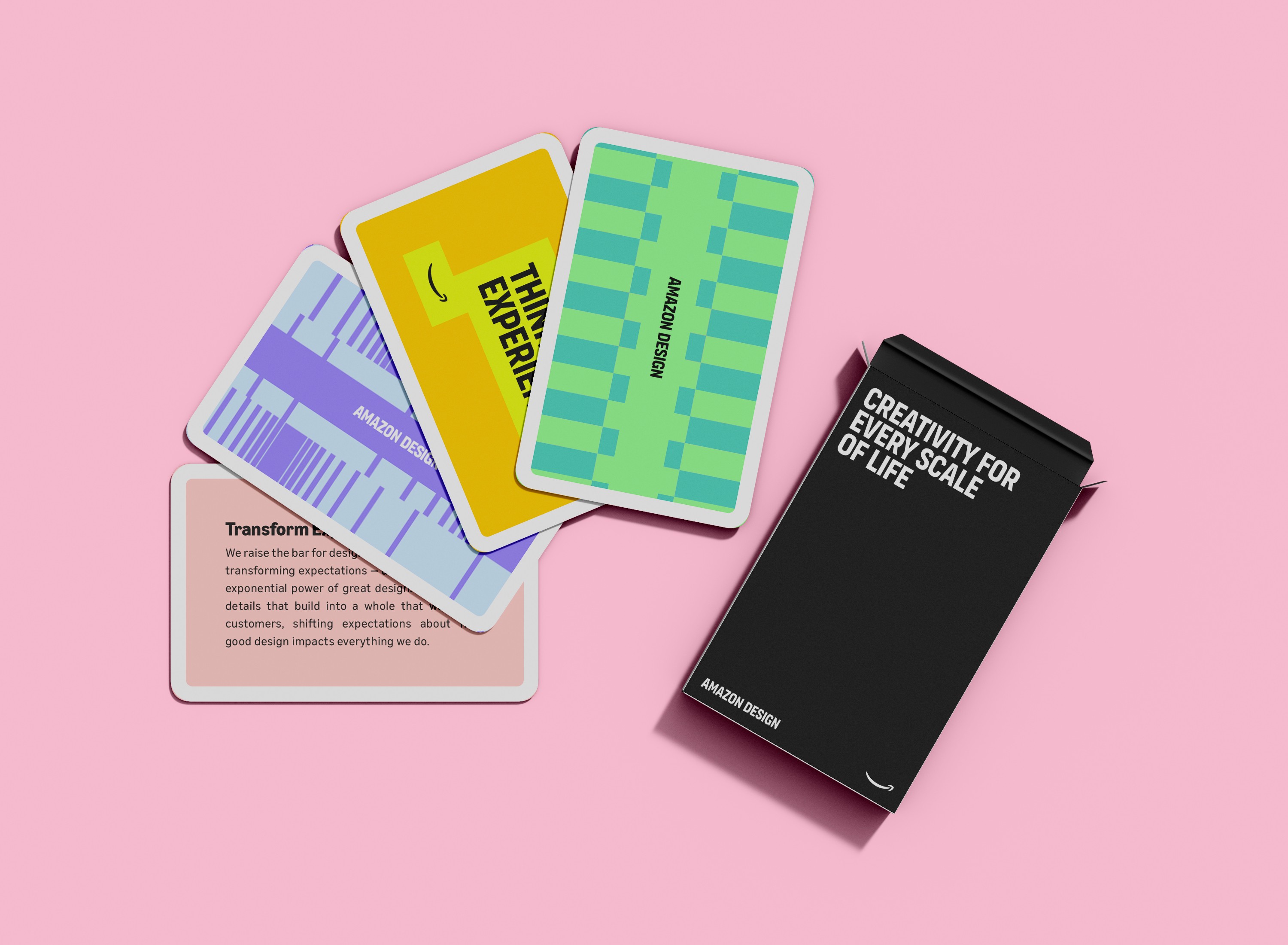
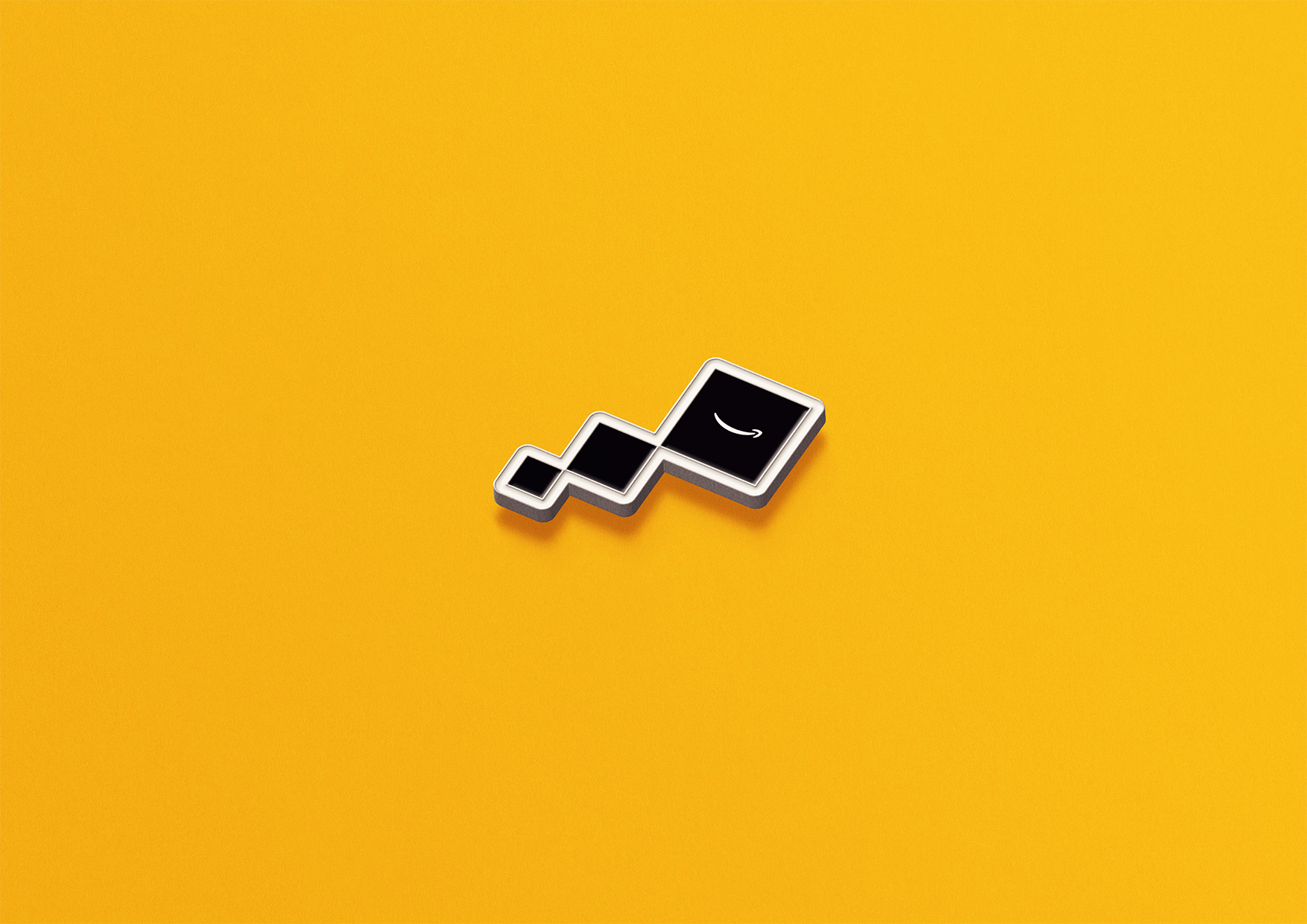
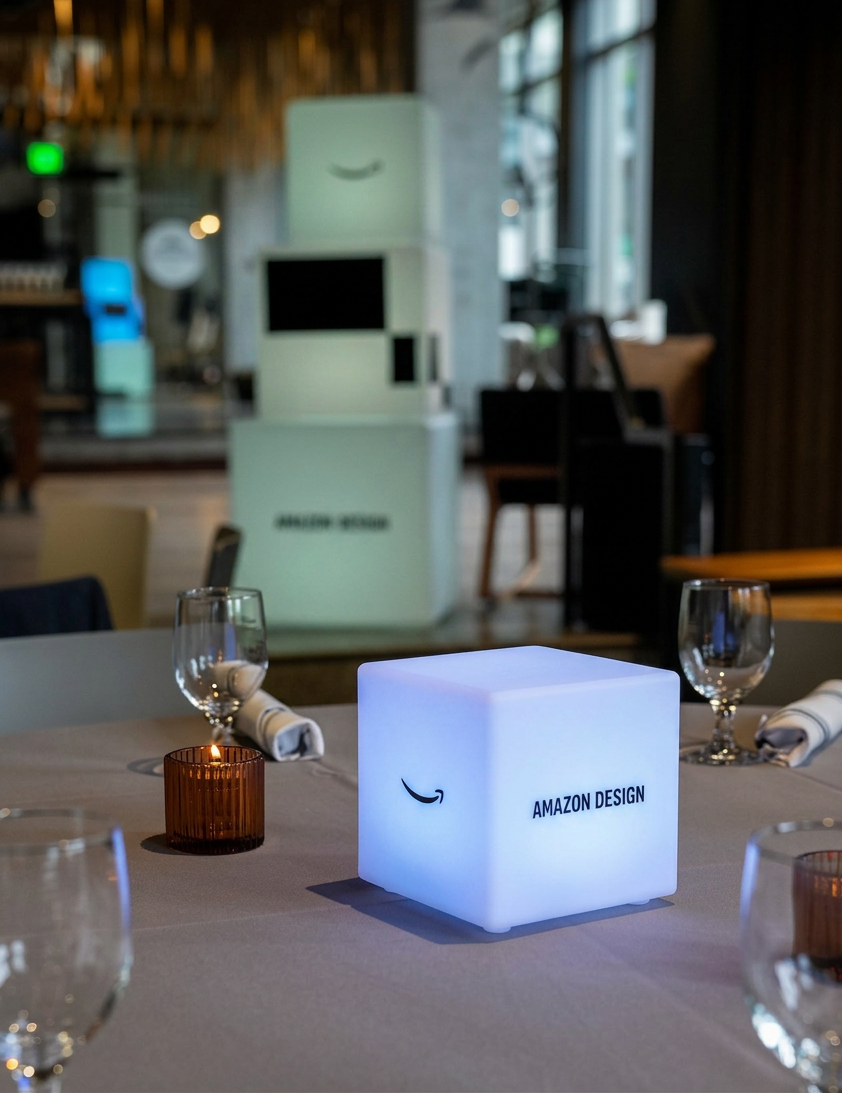
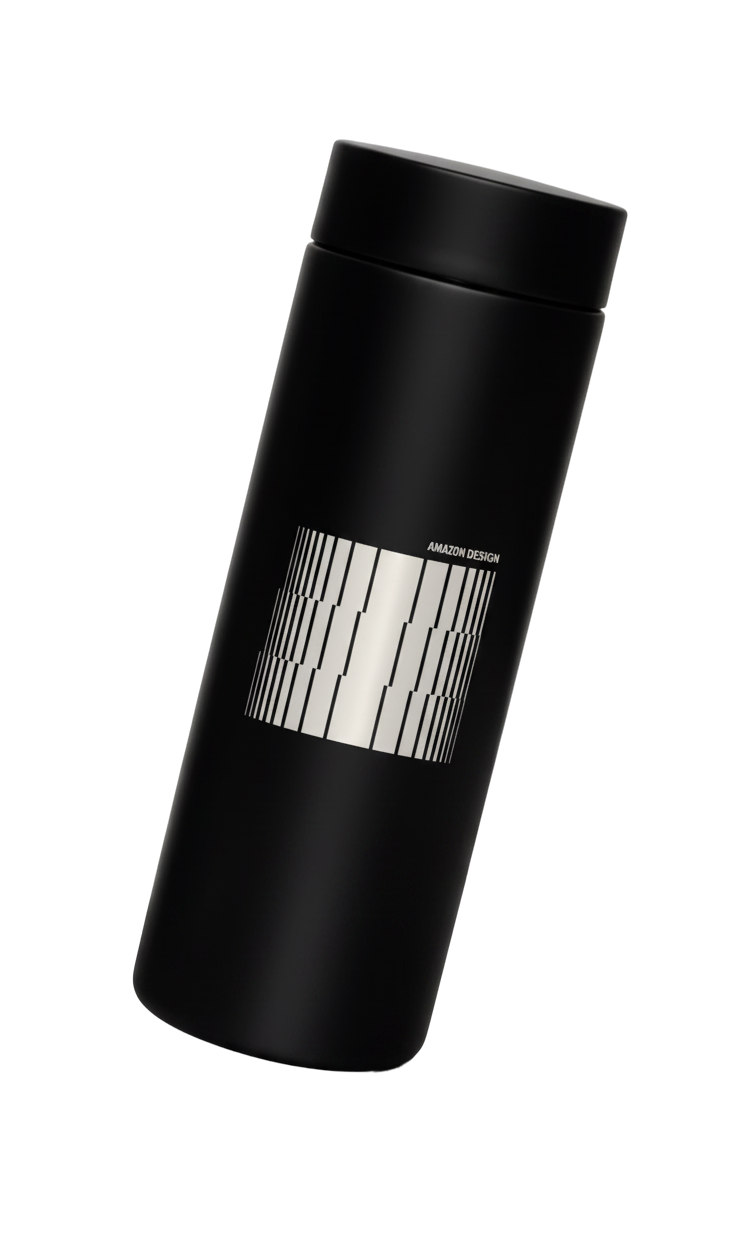
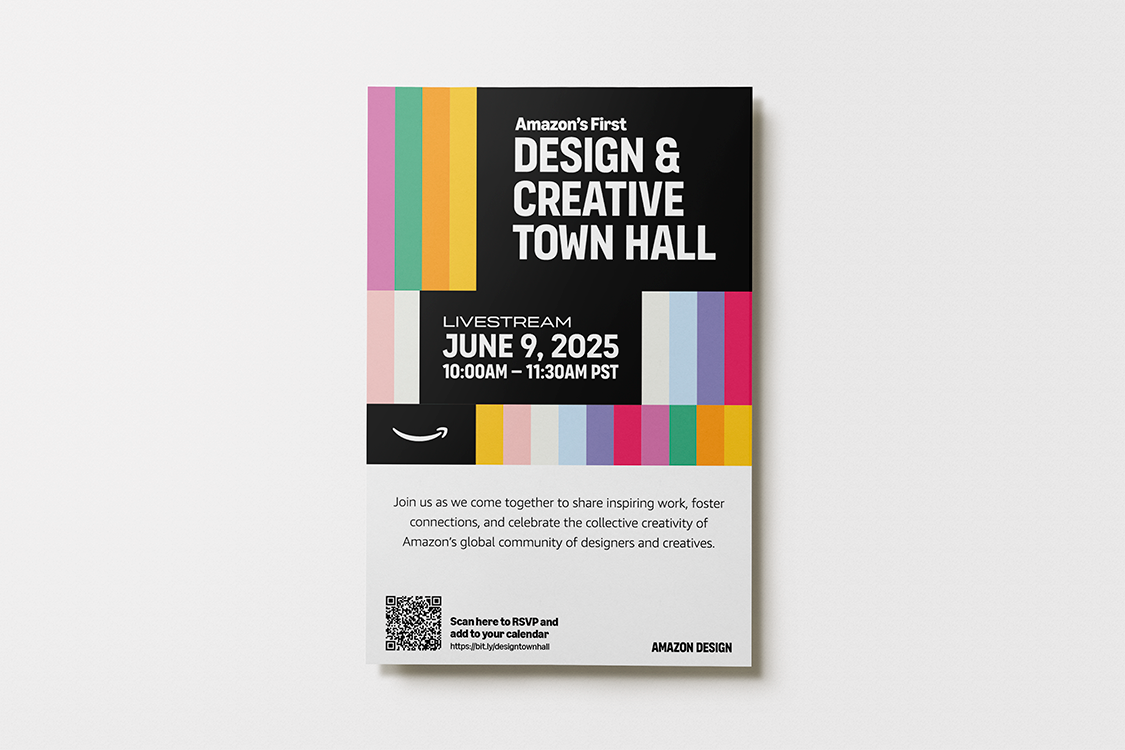
The brand extended across a full range of physical touchpoints — from print and comms to stage pieces and event signage. Many were custom jobs spec'd from the ground up, with material, substrate, and production method determined as part of the design process. Each piece was a judgment call about how far the system could flex across format and substrate while still reading as coherent.
Impact & reflection
80%
Hub traffic growth YoY
3.5 → 3.9
Community Sentiment Score 2022 – 2024
The October 2024 launch drove 80%+ year-over-year growth in amazon.design traffic and improved design community sentiment from 3.5 to 3.9 on a 5-point scale, measured in a community-wide survey. The launch also included an internal design hub — a unified space for tools, training, resources, events, and systems that gave the designers and creatives a centralized point of access for the first time.
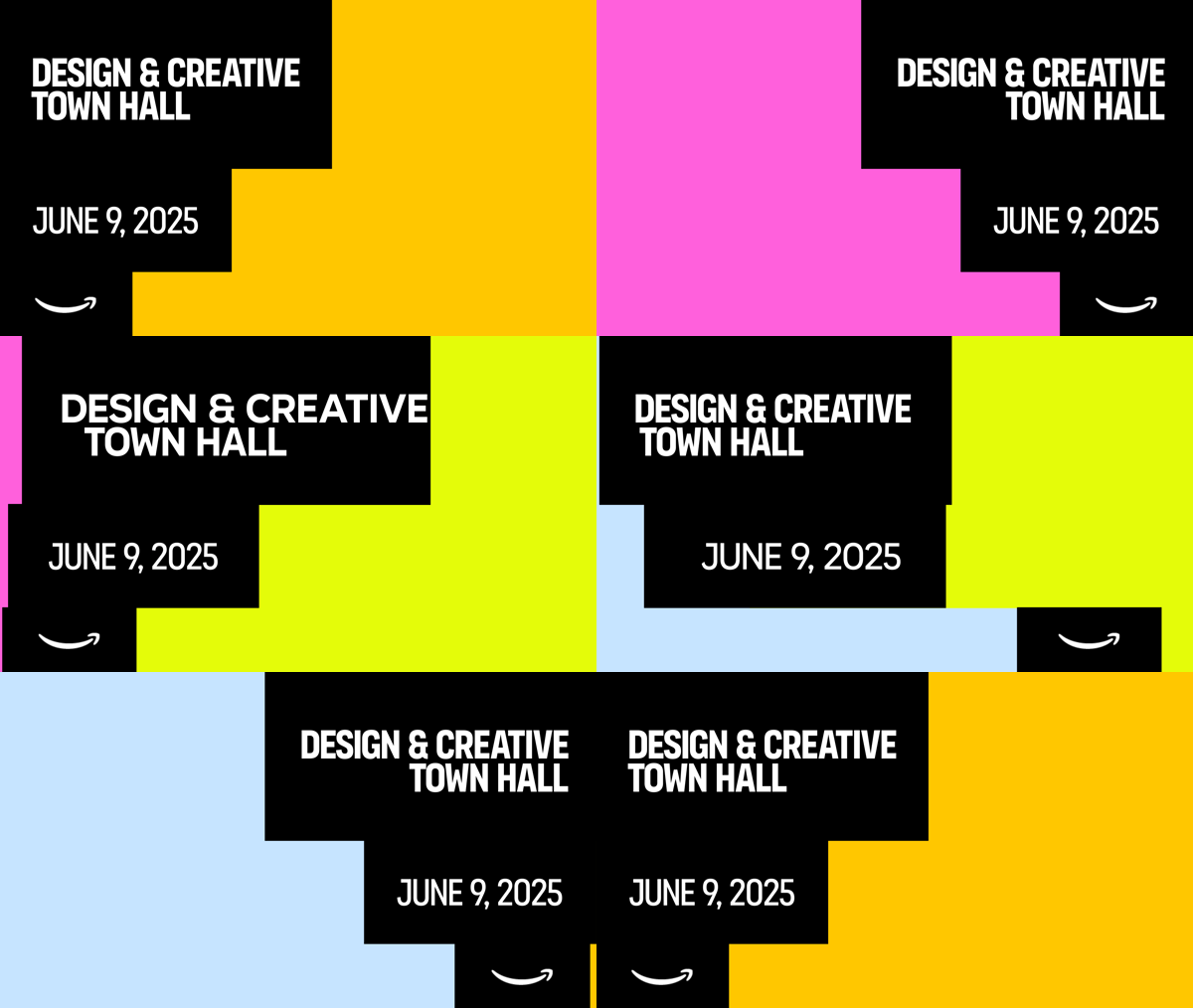
Engagement followed. Senior design leadership including S-level Jassy-directs increased their interest and participation in ADX programming, a Design Leadership Summit was hosted by ADX in March 2025, and an in June 2025 the inaugural Design & Creative Town Hall — built around the new brand — drew 2,100+ Amazonians, far exceeding expectations.
Shortly after launch, Amazon's Cross-Channel Marketing brand team (XCM) released a comprehensive brand refresh aimed at unifying everything within Amazon's ecosystem — which put our system in direct conflict with new parent-level guidelines. What followed was a period of negotiation: ADX had a distinct brand voice worth preserving, and XCM had legitimate organizational goals. Much of my remaining engagement was spent intimately mapping the overlapping Amazon brand ecosystem, educating my team on where our system sat within it, and making decisions about how the ADX brand could interact with those broader goals without losing what made it distinct.
Near the end of my contract, I mapped Amazon's organizational structure relative to the the Design & Creative Community, brand territory, and system architecture into an AI-agent via Quick Suite — giving the team a resource that could field brand and design questions at scale after my departure. It was the most honest answer I could give to the question of what happens to a system when the person who built it leaves, especially within circumstances where the architecture is shifting.
It's worth noting that the system shown here reflects the work at launch. Subsequent XCM compliance requirements have led to modifications in how the brand exists today — a reminder that inside large organizations, a brand system is never truly finished, and the forces shaping it don't stop at launch.
If I were doing it again, I'd push earlier for a fully collaborative relationship with XCM — even so, I can’t say for certain how impactful this would have been given the timing of their own respective launch and the capacity of their team. Brand systems inside large organizations don't exist in isolation — and the sooner that's treated as a design constraint rather than an external variable, the better.
Helms Workshop →

Amazon Design
The Amazon Design Excellence team led a rebrand for Amazon's global design community. Athletics NYC built the strategic framework — then handed it off. I came in to resolve the identity, build the application layer, and get it across the finish line.
March 2024 – October 2024
Brand Design
Creative Direction
Visual Designer
Production
Context
My role was Visual Designer on the Amazon Design Excellence, a six-person team within Amazon's Devices and Services organization — responsible for brand application, system development, and production across all touchpoints. Athletics NYC had led strategy and framework development through early 2024; what they couldn't fully resolve from the outside became my scope. The brand went live in October 2024, approximately six months after handoff.
Opportunity
Two problems needed solving. The first was completion — Athletics had delivered roughly 80% of the system, but the core identity was unresolved, the application layer unbuilt, and the guidelines unwritten. The second was scale — ADX serves 5,000+ designers across Amazon, and a brand system is only as useful as the people who can operate it. Whatever got built needed to work without a designer in the room.
Key tension: The agency engagement had ended before the system was complete, leaving the core identity unresolved and the application layer unbuilt.
Process
Landing the Core Identity
Athletics had presented multiple wordmark directions without landing on something the team could commit to. The gap wasn't in the quality of their work — it was in the internal context an outside agency can only partially access. I worked within the existing direction, stress-testing decisions with my team and creative director across the wordmark, type system, color behavior, photography, scale, and acceptable use until we reached something resolved — the fixed point everything else would reference.
Building the Application Layer
With the identity resolved, the work shifted to the system in the world — physical activations across conferences and events, collateral, motion, and the amazon.design hub. The template system was built around the tools non-designers actually had access to, so anyone could produce on-brand work without routing through a designer (namely recruiting and the ADX team). Additionally, this brand was aimed directly at designers who will certainly let it be known if there are incongruities in how a system is communicated.
Designing for Scale
The brand couldn't live with the ADX (particularly myself, as the only designer) as its sole operator. I built a template system across multiple platforms and formats — accounting for real constraints like security limitations and the tools non-designers actually had access to — so anyone could produce on-brand work independently. Presentations, recruiting materials, learning and development assets: the goal was removing the design team as a bottleneck without sacrificing quality.
The Work
The following work spans the full arc of the engagement — from identity resolution through physical activation, digital application, and templates. Where relevant, context is provided for work that didn't reach final deployment.
Design Hub
The amazon.design hub launched alongside the brand in October 2024 as a unified home for Amazon's design and creative community — an internal portal consolidating tools, resources, and information for employees, and an external-facing site focused on recruiting and representing the work Amazonians do. My contributions spanned both: interface and experience design, content design, scroll-interactive motion, and deployment across the internal and external properties.
Content Systems
The brand guidelines documented a flexible content system for use across the hub, communications, and programming — covering illustration style, photography direction, color application, and content card design. The system extended to owned social channels, with assets designed and deployed across LinkedIn and YouTube. Built as a toolkit to give non-designers, external partners, and teams enough guidance to produce on-brand content independently.
Physical Activations
The brand extended across a full range of physical touchpoints — from print and comms to stage pieces and event signage. Many were custom jobs spec'd from the ground up, with material, substrate, and production method determined as part of the design process. Each piece was a judgment call about how far the system could flex across format and substrate while still reading as coherent.
Impact & reflection
80%
Hub traffic growth YoY
3.5 → 3.9
Community Sentiment Score 2022 – 2024
The October 2024 launch drove 80%+ year-over-year growth in amazon.design traffic and improved design community sentiment from 3.5 to 3.9 on a 5-point scale, measured in a community-wide survey. The launch also included an internal design hub — a unified space for tools, training, resources, events, and systems that gave the designers and creatives a centralized point of access for the first time.
Engagement followed. Senior design leadership including S-level Jassy-directs increased their interest and participation in ADX programming, a Design Leadership Summit was hosted by ADX in March 2025, and an in June 2025 the inaugural Design & Creative Town Hall — built around the new brand — drew 2,100+ Amazonians, far exceeding expectations.
Shortly after launch, Amazon's Cross-Channel Marketing brand team (XCM) released a comprehensive brand refresh aimed at unifying everything within Amazon's ecosystem — which put our system in direct conflict with new parent-level guidelines. What followed was a period of negotiation: ADX had a distinct brand voice worth preserving, and XCM had legitimate organizational goals. Much of my remaining engagement was spent intimately mapping the overlapping Amazon brand ecosystem, educating my team on where our system sat within it, and making decisions about how the ADX brand could interact with those broader goals without losing what made it distinct.
Near the end of my contract, I mapped Amazon's organizational structure relative to the the Design & Creative Community, brand territory, and system architecture into an AI-agent via Quick Suite — giving the team a resource that could field brand and design questions at scale after my departure. It was the most honest answer I could give to the question of what happens to a system when the person who built it leaves, especially within circumstances where the architecture is shifting.
It's worth noting that the system shown here reflects the work at launch. Subsequent XCM compliance requirements have led to modifications in how the brand exists today — a reminder that inside large organizations, a brand system is never truly finished, and the forces shaping it don't stop at launch.
If I were doing it again, I'd push earlier for a fully collaborative relationship with XCM — even so, I can’t say for certain how impactful this would have been given the timing of their own respective launch and the capacity of their team. Brand systems inside large organizations don't exist in isolation — and the sooner that's treated as a design constraint rather than an external variable, the better.
Helms Workshop →

Amazon Design
The Amazon Design Excellence team led a rebrand for Amazon's global design community. Athletics NYC built the strategic framework — then handed it off. I came in to resolve the identity, build the application layer, and get it across the finish line.
March 2024 – October 2024
Brand Design
Creative Direction
Visual Designer
Production
Context
My role was Visual Designer on the Amazon Design Excellence, a six-person team within Amazon's Devices and Services organization — responsible for brand application, system development, and production across all touchpoints. Athletics NYC had led strategy and framework development through early 2024; what they couldn't fully resolve from the outside became my scope. The brand went live in October 2024, approximately six months after handoff.
Opportunity
Two problems needed solving. The first was completion — Athletics had delivered roughly 80% of the system, but the core identity was unresolved, the application layer unbuilt, and the guidelines unwritten. The second was scale — ADX serves 5,000+ designers across Amazon, and a brand system is only as useful as the people who can operate it. Whatever got built needed to work without a designer in the room.
Key tension: The agency engagement had ended before the system was complete, leaving the core identity unresolved and the application layer unbuilt.
Process
Landing the Core Identity
Athletics had presented multiple wordmark directions without landing on something the team could commit to. The gap wasn't in the quality of their work — it was in the internal context an outside agency can only partially access. I worked within the existing direction, stress-testing decisions with my team and creative director across the wordmark, type system, color behavior, photography, scale, and acceptable use until we reached something resolved — the fixed point everything else would reference.
Building the Application Layer
With the identity resolved, the work shifted to the system in the world — physical activations across conferences and events, collateral, motion, and the amazon.design hub. The template system was built around the tools non-designers actually had access to, so anyone could produce on-brand work without routing through a designer (namely recruiting and the ADX team). Additionally, this brand was aimed directly at designers who will certainly let it be known if there are incongruities in how a system is communicated.
Designing for Scale
The brand couldn't live with the ADX (particularly myself, as the only designer) as its sole operator. I built a template system across multiple platforms and formats — accounting for real constraints like security limitations and the tools non-designers actually had access to — so anyone could produce on-brand work independently. Presentations, recruiting materials, learning and development assets: the goal was removing the design team as a bottleneck without sacrificing quality.
The Work
The following work spans the full arc of the engagement — from identity resolution through physical activation, digital application, and templates. Where relevant, context is provided for work that didn't reach final deployment.
Design Hub
The amazon.design hub launched alongside the brand in October 2024 as a unified home for Amazon's design and creative community — an internal portal consolidating tools, resources, and information for employees, and an external-facing site focused on recruiting and representing the work Amazonians do. My contributions spanned both: interface and experience design, content design, scroll-interactive motion, and deployment across the internal and external properties.
Content Systems
The brand guidelines documented a flexible content system for use across the hub, communications, and programming — covering illustration style, photography direction, color application, and content card design. The system extended to owned social channels, with assets designed and deployed across LinkedIn and YouTube. Built as a toolkit to give non-designers, external partners, and teams enough guidance to produce on-brand content independently.
Physical Activations
The brand extended across a full range of physical touchpoints — from print and comms to stage pieces and event signage. Many were custom jobs spec'd from the ground up, with material, substrate, and production method determined as part of the design process. Each piece was a judgment call about how far the system could flex across format and substrate while still reading as coherent.
Impact & reflection
80%
Hub traffic growth YoY
3.5 → 3.9
Community Sentiment Score 2022 – 2024
The October 2024 launch drove 80%+ year-over-year growth in amazon.design traffic and improved design community sentiment from 3.5 to 3.9 on a 5-point scale, measured in a community-wide survey. The launch also included an internal design hub — a unified space for tools, training, resources, events, and systems that gave the designers and creatives a centralized point of access for the first time.
Engagement followed. Senior design leadership including S-level Jassy-directs increased their interest and participation in ADX programming, a Design Leadership Summit was hosted by ADX in March 2025, and an in June 2025 the inaugural Design & Creative Town Hall — built around the new brand — drew 2,100+ Amazonians, far exceeding expectations.
Shortly after launch, Amazon's Cross-Channel Marketing brand team (XCM) released a comprehensive brand refresh aimed at unifying everything within Amazon's ecosystem — which put our system in direct conflict with new parent-level guidelines. What followed was a period of negotiation: ADX had a distinct brand voice worth preserving, and XCM had legitimate organizational goals. Much of my remaining engagement was spent intimately mapping the overlapping Amazon brand ecosystem, educating my team on where our system sat within it, and making decisions about how the ADX brand could interact with those broader goals without losing what made it distinct.
Near the end of my contract, I mapped Amazon's organizational structure relative to the the Design & Creative Community, brand territory, and system architecture into an AI-agent via Quick Suite — giving the team a resource that could field brand and design questions at scale after my departure. It was the most honest answer I could give to the question of what happens to a system when the person who built it leaves, especially within circumstances where the architecture is shifting.
It's worth noting that the system shown here reflects the work at launch. Subsequent XCM compliance requirements have led to modifications in how the brand exists today — a reminder that inside large organizations, a brand system is never truly finished, and the forces shaping it don't stop at launch.
If I were doing it again, I'd push earlier for a fully collaborative relationship with XCM — even so, I can’t say for certain how impactful this would have been given the timing of their own respective launch and the capacity of their team. Brand systems inside large organizations don't exist in isolation — and the sooner that's treated as a design constraint rather than an external variable, the better.